
A useful writing portfolio lets a buyer read the finished work and check the decisions behind it. These two practice briefs show different problems: helping a reader compare notebook formats, then describing a bag without inventing durability or environmental claims.
Both brands and briefs are fictional. The finished text is an educational example created for this site. If you adapt it, identify the adaptation and show the work you changed; do not present it as a commissioned project.
Brief one: make three notebooks easy to compare
Paper Lantern needs a factual title and a short description for each SKU. The audience is students comparing size, page layout and binding. Deliver selectable text in an editable document. Photography, keyword research and store uploading are outside this brief.
| SKU | Size and layout | Other supplied facts |
|---|---|---|
| PL-A5 | A5; 80 lined pages | Kraft cover; sewn binding |
| PL-DOTP | A6; 64 dot-grid pages | Blue card cover; stapled binding |
| PL-PLAN | A5; 52 undated weekly spreads | Green cover; spiral binding |
The brief supplies no paper weight, water resistance, recycled content, delivery promise or sales result. Keep those out of the final copy.
Finished notebook copy
Everyday A5 Notebook — 80 Lined Pages
Keep class notes and reading lists together in an A5 notebook with 80 lined pages. The kraft cover gives it a plain finish, and sewn binding holds the pages together. Choose this format when you want ruled lines for written notes.
Pocket A6 Notebook — 64 Dot-Grid Pages
Plan a layout or keep short notes on 64 dot-grid pages. This A6 notebook has a blue card cover and stapled binding. Compare its smaller format with the A5 option before choosing. Paper weight and suitability for wet media are not specified.
Undated A5 Planner — 52 Weekly Spreads
Organise appointments and tasks one week at a time. This A5 planner has 52 undated weekly spreads, a green cover and spiral binding. Start on the week you choose without crossing out printed dates.
Why the revision is stronger
| Weak phrase | Problem | Editing decision |
|---|---|---|
| “Great quality for everything” | Gives no comparison detail | Lead with size and layout |
| “Waterproof artist journal” | Neither claim is supported | Describe the cover and flag missing paper information |
| “Become 10x more productive” | Invents a measurable result | Explain the undated weekly format |
“Useful for notes” describes a plausible use. “Best for every student” claims superiority and universal suitability. A fact check should catch that distinction even when a sentence sounds natural.
Brief two: a canvas tote with incomplete specifications
Harbour Thread is an invented shop. It supplies these facts for HT-01: cotton canvas, 38 × 42 cm body, two handles, an open top, an inside pocket, natural colour, and a care instruction to spot clean. No load rating, fabric weight, certification, origin or waterproofing is supplied. The reader wants to know what the bag contains and how it closes.
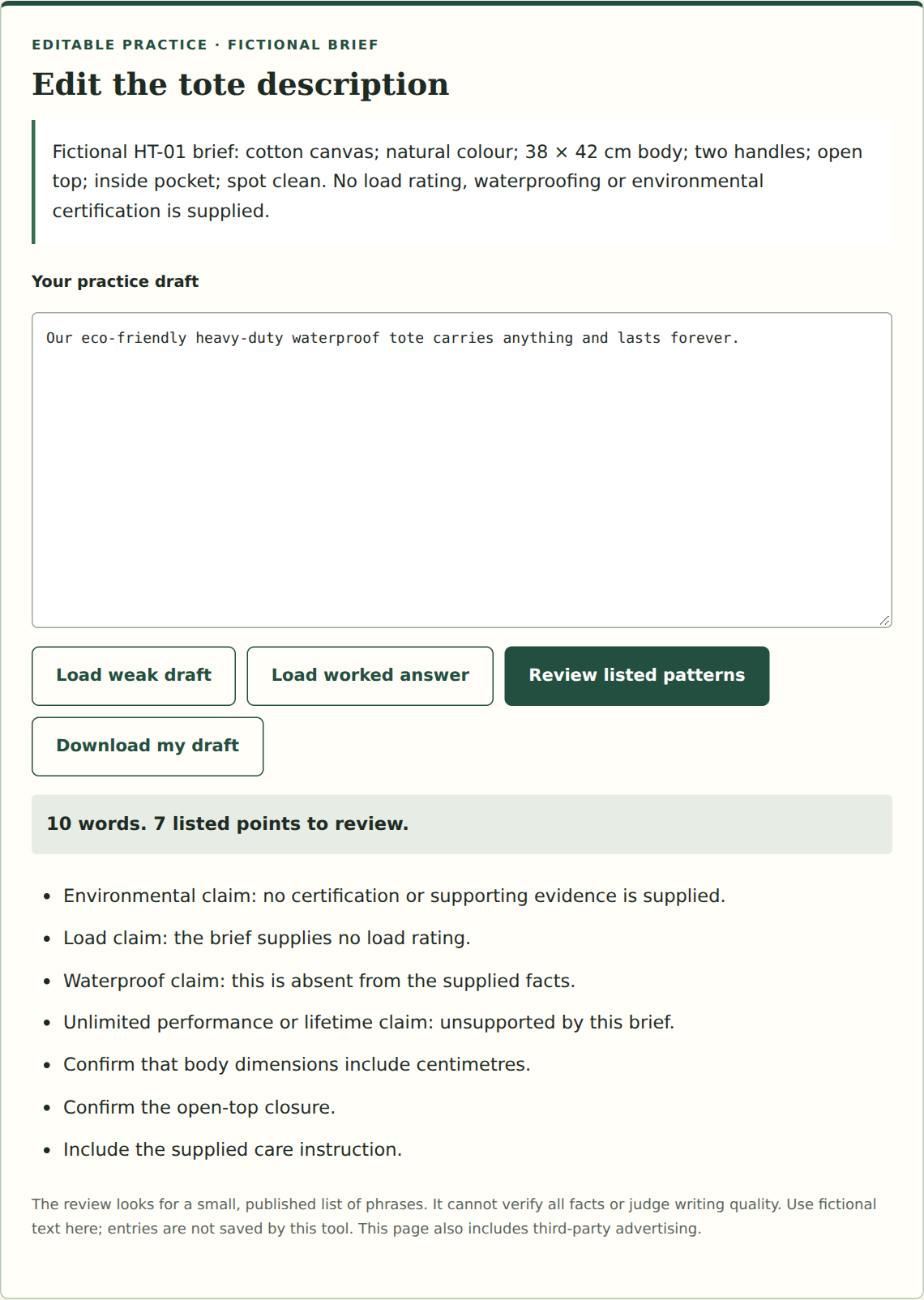
Weak draft: “Our eco-friendly heavy-duty waterproof tote carries anything and lasts forever.”
Finished title: Natural Cotton Canvas Tote — 38 × 42 cm, Inside Pocket
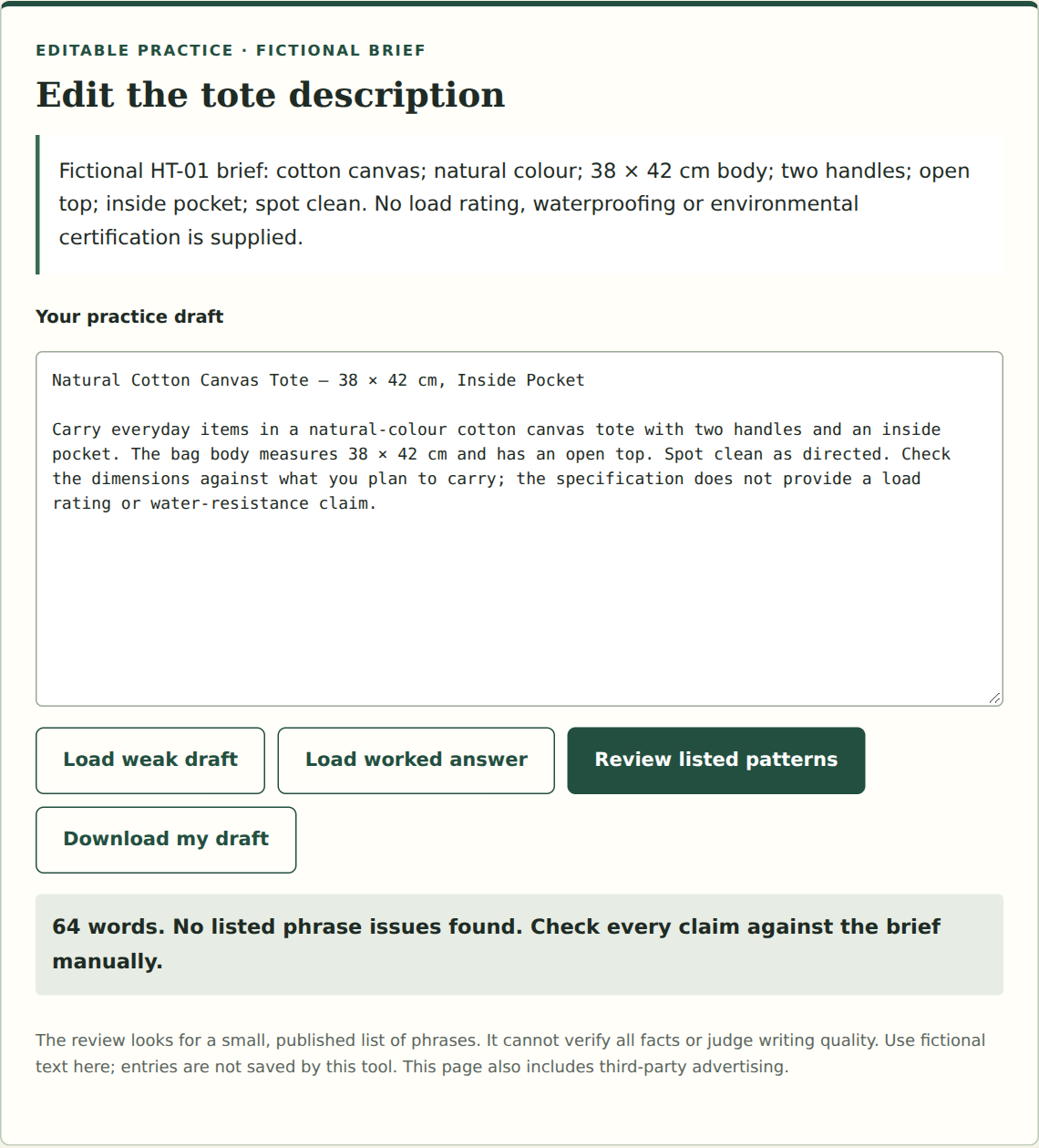
Finished description: Carry everyday items in a natural-colour cotton canvas tote with two handles and an inside pocket. The bag body measures 38 × 42 cm and has an open top. Spot clean as directed. Check the dimensions against what you plan to carry; the specification does not provide a load rating or water-resistance claim.
This brief needs different decisions from the notebook exercise. The closure affects use, dimensions need units, and the care instruction belongs in the copy. Cotton alone does not prove an environmental claim. An inside pocket does not imply a zip. A photo cannot supply a load rating.
Package one inspectable portfolio entry
Use five parts: practice label, brief, approved facts, final copy, and three editing decisions. Show the finished copy before a long process narrative. Keep the brief available so a reviewer can check it without requesting access. The downloadable examples contain both input and output.
Review your own version by asking someone to identify the main difference between the notebook products, or to explain how the tote closes. Record only feedback you actually receive. If you work alone, do a separate next-day review and describe it as your own review.
For a new sample, change the product category and the problem, not just the brand name. Try a service description with a cancellation window supplied by the brief, or a furniture listing where assembly and dimensions matter. Do not invent the missing policy or specifications to make the page look finished.
Edit the actual practice draft
Use the supplied facts, load the weak draft, then revise it or compare it with the worked answer. The captures show the weak teaching draft and worked revision in this editor. The brief and results are fictional practice work.
Edit the tote description
Fictional HT-01 brief: cotton canvas; natural colour; 38 × 42 cm body; two handles; open top; inside pocket; spot clean. No load rating, waterproofing or environmental certification is supplied.
Use the brief to write your own version, then review it.
The review looks for a small, published list of phrases. It cannot verify all facts or judge writing quality. Use fictional text here; entries are not saved by this tool. This page also includes third-party advertising.
Practice work and illustrative amounts are labelled in the article. See how we prepare and correct guides and how the resource checks work. Report a specific error or broken step.